ESG Risk Management: A Strategic Framework for Sustainable Success

Table of Contents

  1. Introduction: The ESG Imperative in Modern Business
  2. What is ESG Risk Management? Moving Beyond Compliance
  3. The Three Pillars of ESG: A Comprehensive Framework
  4. Systematic vs. Unsystematic ESG Risks: A Core Distinction
  5. How to Implement an ESG Risk Management Framework
  6. An Overview of Key ESG Reporting Frameworks
  7. Conclusion: Turning ESG Risk into a Strategic Advantage
  8. Introduction: The ESG Imperative in Modern Business

Introduction: The ESG Imperative in Modern Business

The contemporary business landscape is undergoing a fundamental shift. Environmental, Social, and Governance (ESG) factors are no longer peripheral concerns but central drivers of corporate risk and strategic opportunity. This is not a passing trend but a structural change in how organizations create and sustain long-term value.

Recent data underscores the magnitude of this transformation. The 2023 EY Global C-suite Insights Survey reveals that over 81% of organizations have established Chief Sustainability Officer (CSO) positions or equivalent leadership roles, with 90% of executives reporting board-level oversight of ESG agendas (Watson et al., 2023).

This article is the second installment in our AI-Driven Risk Management series, building on our foundational post on understanding systematic risk. We apply the core principle, that total risk is the sum of systematic and unsystematic risks, specifically to the ESG domain. We demonstrate how market-wide (systematic) and company-specific (unsystematic) ESG factors combine to form an organization’s comprehensive ESG risk profile.

What is ESG Risk Management? Moving Beyond Compliance

ESG provides a tangible framework for evaluating an organization’s impact across three critical dimensions. Unlike broader concepts like Corporate Social Responsibility (CSR), ESG offers measurable criteria that enable data-driven decision-making for companies and investors alike.

The strategic imperative for ESG management stems from several interconnected forces: powerful market pressures, evolving regulations, and shifting stakeholder expectations. Investors are systematically integrating ESG factors into asset management, while regulators like the EU are implementing stringent requirements such as the Corporate Sustainability Reporting Directive (CSRD). Failure to adapt exposes organizations to significant financial, regulatory, and reputational damage.

Ultimately, proactive ESG management is directly linked to financial performance.

A 2023 study by the IBM Institute for Business Value found that organizations recognized as ESG leaders are 43% more likely to outperform peers in profitability.

– (Krantz & Jonker, 2023)

This evidence reframes ESG not as a cost center, but as a critical driver of competitive advantage and long-term resilience.

The Three Pillars of ESG: A Comprehensive Framework

Effective ESG management requires a holistic assessment of three interconnected pillars:

  • Environmental: This pillar examines an organization’s impact on the natural world. It covers climate change mitigation, greenhouse gas (GHG) emissions management, resource depletion, waste, and pollution. Key risk categories include Transition Risks (e.g., from carbon pricing) and Physical Risks (e.g., from extreme weather events).
  • Social: The social dimension addresses a company’s relationship with its employees, customers, and the communities in which it operates. Key areas include diversity and inclusion, human rights, labor standards, data privacy, and supply chain ethics. Strong social performance enhances brand reputation and talent retention.
  • Governance: This focuses on a company’s leadership, internal controls, and shareholder rights. Critical elements include board composition, executive compensation, transparency in reporting, and ethical business conduct. Robust governance reduces operational risks and builds stakeholder confidence.

Systematic vs. Unsystematic ESG Risks: A Core Distinction

As established in the first article of our series, an organization’s total risk can be decomposed into two parts. This principle is directly applicable to ESG risk:

Total ESG Risk = Systematic ESG Risk + Unsystematic ESG Risk

  • Systematic ESG Risk: These are market-wide ESG factors affecting all organizations within a sector or economy. Examples include sweeping climate regulations, major shifts in societal attitudes toward sustainability, or global supply chain disruptions from environmental events. These risks cannot be diversified away and require systemic, industry-level responses.
  • Unsystematic ESG Risk: These are company-specific ESG factors unique to an individual organization. Examples include a governance scandal, a localized environmental incident, a labor dispute, or an ethical violation in the company’s supply chain. These risks can often be mitigated through effective internal controls and strategic management.

Understanding this decomposition allows organizations to develop targeted strategies that address both broad industry challenges and unique internal vulnerabilities.

CategorySystematic RisksUnsystematic Risks
ImpactAffects a wide range of securities across the whole market or a market segmentLimited to a particular industry, company, or market segment
NatureCannot be controlled, minimized, or avoided by managementCan be managed, minimized, or completely avoided by management
FactorsDriven by external or macroeconomic events (e.g., geopolitical, economic, social)Stemming from internal or microeconomic conditions
ProtectionManaged through strategic asset allocationManaged through portfolio diversification
AvoidabilityUnavoidableAvoidable and resolvable
TypesIncludes purchasing power risk, interest rate risk, and market riskIncludes business-specific and financial risk

Figure 1: Systematic vs. Unsystematic Components of Total ESG Risk

How to Implement an ESG Risk Management Framework

Effective ESG risk management is a systematic process of identifying, assessing, and mitigating risks and opportunities. A successful framework is built on a deep understanding of stakeholder expectations, as they are the primary drivers of ESG priorities.

Stakeholders, from investors and regulators to customers and employees, are collectively raising the bar. Investors demand transparency and integrate ESG data into their decision-making. Regulators are creating complex compliance obligations. Customers and employees prefer to align themselves with socially and environmentally responsible brands. Supplier and Value Chain Pressures, this creates cascading effects throughout value chains, compelling businesses to adopt sustainable and ethical practices across their entire operational ecosystem. A modern ESG framework must therefore be designed to address these diverse, and sometimes competing, demands in a coherent and strategic manner.

An Overview of Key ESG Reporting Frameworks

Robust measurement and transparent reporting are the cornerstones of effective ESG management. Several key frameworks provide standardized guidelines to help organizations communicate their performance to stakeholders:

  • European Sustainability Reporting Standards (ESRS): A set of mandatory standards under the EU’s CSRD. They require disclosures based on a “double materiality” approach, addressing both the company’s impact on society and the environment, and the financial risks posed by sustainability issues.
  • Task Force on Climate-related Financial Disclosures (TCFD): The global benchmark for climate-related financial risk disclosure. Its recommendations are structured around four core areas: Governance, Strategy, Risk Management, and Metrics & Targets.
  • Sustainability Accounting Standards Board (SASB): Provides industry-specific standards focused on the financially material sustainability topics most likely to impact enterprise value. This enhances the relevance and comparability of disclosures for investors.
  • Global Reporting Initiative (GRI): A comprehensive framework for reporting on economic, environmental, and social impacts. GRI standards emphasize stakeholder engagement and materiality to focus reporting on the most significant issues.
  • Integrated Reporting Framework: An integration of thinking that connects financial and non-financial information, demonstrating how organizations create value over time through effective management of financial, manufactured, intellectual, human, social, and natural capital.

Conclusion: Turning ESG Risk into a Strategic Advantage

In today’s business environment, success increasingly depends on an organization’s ability to manage ESG risks with strategic foresight. As regulatory demands intensify and stakeholder expectations rise, risk management must evolve from a reactive compliance exercise into a proactive engine for value creation.

By integrating robust frameworks with emerging technologies like artificial intelligence, machine learning, and advanced analytics, companies can dramatically enhance risk assessment, prediction, and mitigation. This fusion of technical capability and strategic vision empowers firms not only to navigate the complex ESG landscape but also to unlock innovation, build lasting resilience, and secure a competitive advantage in a rapidly changing world.

References

Krantz, T., & Jonker, A. (2023). What is environmental, social and governance (ESG)? IBM Think. Retrieved from https://www.ibm.com/think/topics/environmental-social-and-governance

Mohebbi, A. (2025). Systematisches Risiko verstehen: Eine Marktkraft, die sich nicht beeinflussen lässt. Procycons. Retrieved from https://procycons.com/de/blogs/systematisches-risiko-verstehen/

UNEP Finance Initiative. (2024). European Sustainability Reporting Standards (ESRS). Retrieved from https://www.unepfi.org/impact/interoperability/european-sustainability-reporting-standards-esrs/

Watson, R., Bergman, R., Firth, C., & Schreiber, C. (2023). The EY 2023 Global Cybersecurity Leadership Insights Study shows how leaders are bolstering defenses while creating value. EY Insights. Retrieved from https://www.ey.com/en_gl/insights/consulting/is-your-greatest-risk-the-complexity-of-your-cyber-strategy


Green Logistics: Paths to Greater Sustainability in the Supply Chain

Table of Contents

Sustainability in Logistics: Challenges, Opportunities, and Solutions

The ever-increasing CO2 emissions have a negative impact on the global climate – this is nothing new. The German logistics sector, with emissions of around 20 percent of all greenhouse gas emissions, makes a significant contribution to this and is therefore faced with various challenges. The industry is caught between reducing transport costs and the pressure to reduce emissions in order to comply with increasingly stringent legal requirements. There are several legal regulations such as the Climate Protection Act and, in shipping, the IMO regulation, which limits the sulfur emissions of ships and increases the prices for fuel for ships and trucks.

However, the implementation of climate neutrality is not progressing as quickly as it should. A major reason is that many approaches to reducing greenhouse gases represent a significant financial burden for companies. Arguably the biggest challenge facing the logistics industry is the ability to use sustainably produced fuels and modernize its own vehicle fleet. It is more necessary than ever to introduce green technologies in the logistics sector in order to promote sustainability. At the same time, this offers the opportunity to increase efficiency and save costs in the medium to long term. However, this requires innovative solutions and the commitment of companies throughout the supply chain.

Sustainable logistics deals with all processes related to the life cycle of products throughout the entire value chain. Areas that are affected by this are procurement, production, delivery, and disposal. However, it is not just about the supply and delivery of goods, raw materials, and/or product parts. It also includes the design of the underlying manufacturing and delivery processes as well as the optimization of both data and information flows. The movement of goods by road, rail, air, and water must be taken into account, as must the processes underlying the supply chain.

The German logistics sector, responsible for around 20 percent of greenhouse gas emissions, faces the challenge of reducing CO2 emissions and promoting sustainability through innovative solutions and green technologies.

What are the Drivers and Goals of Sustainability in Logistics?

It is undoubtedly clear that climate change will continue to accelerate in the coming years – with devastating consequences for people and nature. The state is reacting to this by setting up increasingly strict rules and laws that force companies in the industry to operate more sustainably. Furthermore, the opinion of customers, the pressure of public opinion, and the changes in the market make it necessary to build sustainable supply chains against all odds. Ethical aspects are also playing an increasing role, so that the traceability of deliveries in particular is of increased relevance. In this context, the so-called “Supply Chain Due Diligence Act” (short: Supply Chain Act), which regulates corporate responsibility with regard to compliance with human rights within global supply chains, is important.

To date, the logistics sector, which is exposed to extremely high competitive pressure, does not comply with the legally prescribed limits for CO2 emissions. The goals that are intended to lead to more sustainability in this sector are broadly based. To provide an insight into the various benefits, some are listed here as examples:

  • Reduction of the CO2 footprint for more climate protection
  • Higher resource efficiency, for example through reuse
  • Increased profitability and many competitive advantages
  • Compliance with various legal standards and avoidance of penalties
  • Building a positive brand image and greater customer loyalty

In order to effectively implement these goals in the company, all participants in the logistics sector, such as freight forwarders, railway operators, airlines, and shipping companies, including their upstream and downstream supply chains, must proactively address this change process. Many competent and innovative consulting companies reliably help to optimize their own environmental footprint.

What Methods Exist to Measure Sustainability in Logistics?

For companies in the logistics sector, it is becoming increasingly important, and for many it is a real concern, to reduce their own CO₂ emissions. However, making the reductions achieved fully measurable is not easy – especially when considering the entire supply chain. In order to make the emissions that a company emits measurable, three dimensions must be made visible. This includes

  • making visible the total amount of climate-damaging gases emitted by the company itself
  • measuring the emissions of energy suppliers
  • tracking the emissions of upstream and downstream companies in the supply chain.

Companies must define meaningful Key Performance Indicators (KPIs) in advance in order to be able to actually measure and understand the success of their own company’s sustainability strategy.

To achieve this, there are various software programs from specialists that provide companies in the logistics sector with the measurement values that are necessary for determining the KPIs. One of the most important KPIs is the relative emission reduction of greenhouse gases. A reference point is absolutely necessary for this measurement value. This measurement value is measured in percent and is intended to help determine whether a CO2 reduction target has been achieved.

If such software is used in the company, companies that want to reduce their CO2 footprint can gain valuable data to analyze, monitor, and, if necessary, optimize their entire supply chain. The calculations include the KPIs from the purchasing, warehousing, delivery, logistics, and transport sectors. The measurement criteria are usually time, costs, productivity, and service quality. The presentation and monitoring take place in real time via special software products.

Both Industry 4.0 and Logistics 4.0 – where software products provide valuable information and evaluations to obtain reliable results – have made it much easier to collect the necessary data for analysis in times of advancing digitalization. Therefore, a networking of the special software products of different departments, for example a warehouse management system, is absolutely necessary in order to get to this data. The company’s own ERP system also offers valuable data material from which relevant information and data can be filtered out.

Digital technologies like CarbonPath enable logistics companies to capture, analyze, and effectively reduce their CO₂ footprint.

Which Innovative Technologies Support Sustainability in Logistics?

Through the use of digital technologies, all products and processes in logistics can be designed to be more resource-efficient and therefore more socially responsible. The primary focus is on networking value chains in order to effectively use existing resources and products in the sense of the circular economy and thus strengthen the idea of sustainability. An example product will be examined in more detail.

An innovative tool that can be used in the logistics sector for more sustainability is the software CarbonPath. This software solution includes several functions and is specifically aimed at enabling logistics companies to holistically capture, analyze, and measure their ecological footprint. The goal is to identify all reduction opportunities and bring other stakeholders on board. The measured concrete values regarding the emissions of greenhouse gases from the vehicle fleet can later be exported as a PDF document at the touch of a button for documentation purposes.

What Challenges and Success Factors Characterize Sustainable Logistics?

The modern logistics sector faces various challenges that are difficult for the companies concerned to overcome. Primarily, of course, it is the excessively high CO2 emissions that must be reduced in order to achieve the climate goals. Inefficient resource management, the acute shortage of skilled workers, a lack of transparency within the entire supply chain, and an insufficient level of digitalization are further factors that lead to sometimes massive restrictions on the companies’ freedom of action. Especially in Germany – the country that elevates bureaucracy to new spheres – far too much work is still done on paper

Essential success factors for the design and strategic planning of the implementation are automation through the use of innovative technologies. Automation and robotics, for example, help with the use of warehouse systems and ensure transparency. In order to be able to use the constantly growing volumes of data efficiently, data analysis tools and artificial intelligence help. This can be used to optimize the routes of the entire vehicle fleet. Telematics systems, in turn, enable real-time monitoring of the vehicles on the one hand, and can help to avoid empty runs on the other. The implementation of an ESG concept (where ESG stands for “Environment, Social, Governance”) can be better monitored through continuous KPI measurement.

References

  • https://www.imo.org/en
  • https://www.bmz.de/de/themen/lieferkettengesetz
  • https://gruenderplattform.de/green-economy/green-logistics#vorteile
  • https://www.bito.com/de-ch/fachwissen/artikel/bedeutung-von-kpis-in-der-logistik/
  • https://www.firstaudit.de/blog/allgemein/logistik-4-0/
  • https://carbonpath.eu/
  • https://www.bvl.de/blog/nachhaltigkeit-in-der-logistik-wege-zu-einer-gruneren-und-effizienteren-zukunft/

Achieving Net-Zero: CO₂ Balancing & Decarbonization Strategy

Table of Contents

blog3 zitat1 1920w

Introduction

With the tightening of the Climate Protection Act in the summer of 2021, the German government is setting the cornerstones for the decarbonization of the economy: The Federal Republic of Germany, and thus the entire German economy, must become greenhouse gas neutral by 2045. By 2030, emissions must be reduced by at least 65% (compared to the base year 1990) and by 88% by 2040 (German Federal Government, 2022). By 2030, these reduction targets were also divided into sectors: For the ‘Industry’ sector, a reduction target of 58% applies by 2030 (German Environment Agency, 2022).

For companies, this means: The long-term goal of a company in measuring, recording, and reducing greenhouse gas emissions must always be the ‘climate neutrality’ of the company. The urge to act here is great, not only due to the upcoming national sector targets for 2030 – the sooner action is taken, the sooner net-zero can be achieved and the more surmountable the challenges become.

In the first two articles of the blog series, an overview of the CSRD, existing frameworks, and their requirements, especially regarding climate protection, was given. Against the background of these requirements and the German greenhouse gas reduction targets, this article answers the question of how the path to decarbonization of a company is structured and what sequence of steps is required.

Climate Neutrality versus Greenhouse Gas Neutrality: What is the Difference?

In recent years, the term ‘climate neutrality’ has gained considerable importance. More and more companies, cities, and countries are setting ambitious net-zero targets. By 2021, 70% of the world economy was already covered by such promises. But what does climate neutrality actually mean? And what is the difference to greenhouse gas neutrality or the net-zero target? The Intergovernmental Panel on Climate Change (IPCC) and the German Environment Agency define the terms as follows:

  • Climate neutrality: “Concept of a state in which human activities have no net effect on the climate system. […]” (IPCC, 2018; Sieck/Purr, 2021)
  • Net-zero emissions / Greenhouse gas neutrality: “Net zero emissions are achieved when anthropogenic greenhouse gas emissions (e.g. CO2, CH4) are globally offset by anthropogenic removals over a specified period.” (Sieck/Purr, 2021)

It becomes clear that greenhouse gas neutrality is a prerequisite for climate neutrality. A company can achieve greenhouse gas neutrality, but not necessarily climate neutrality, as it only concerns the temporary net-zero state and not the consequences of human activities. When talking about ‘climate-neutral products’ or ‘climate-neutral companies’, greenhouse gas neutrality is usually meant. Some companies are unable to formulate climate neutrality as a goal due to their size and potential impact, but only greenhouse gas neutrality. It is of fundamental importance how companies achieve net-zero emissions in order to make a serious, long-term contribution to combating climate change.

The Path to Net-Zero

The Corporate Carbon Footprint

On the path to decarbonizing a company, the greenhouse gas balance is the basis for all further analyses, the decarbonization strategy, and the action planning. It represents a basic building block of sustainability management. A Corporate Carbon Footprint is a balance of all direct and indirect greenhouse gas emissions of a company and its value chain.

Procycons uses the Greenhouse Gas (GHG) Protocol of the World Resource Institute and the DIN ISO 14064-1 standard of the International Organization for Standardization for the calculation, which are considered the most internationally recognized standards for the greenhouse gas accounting of companies.

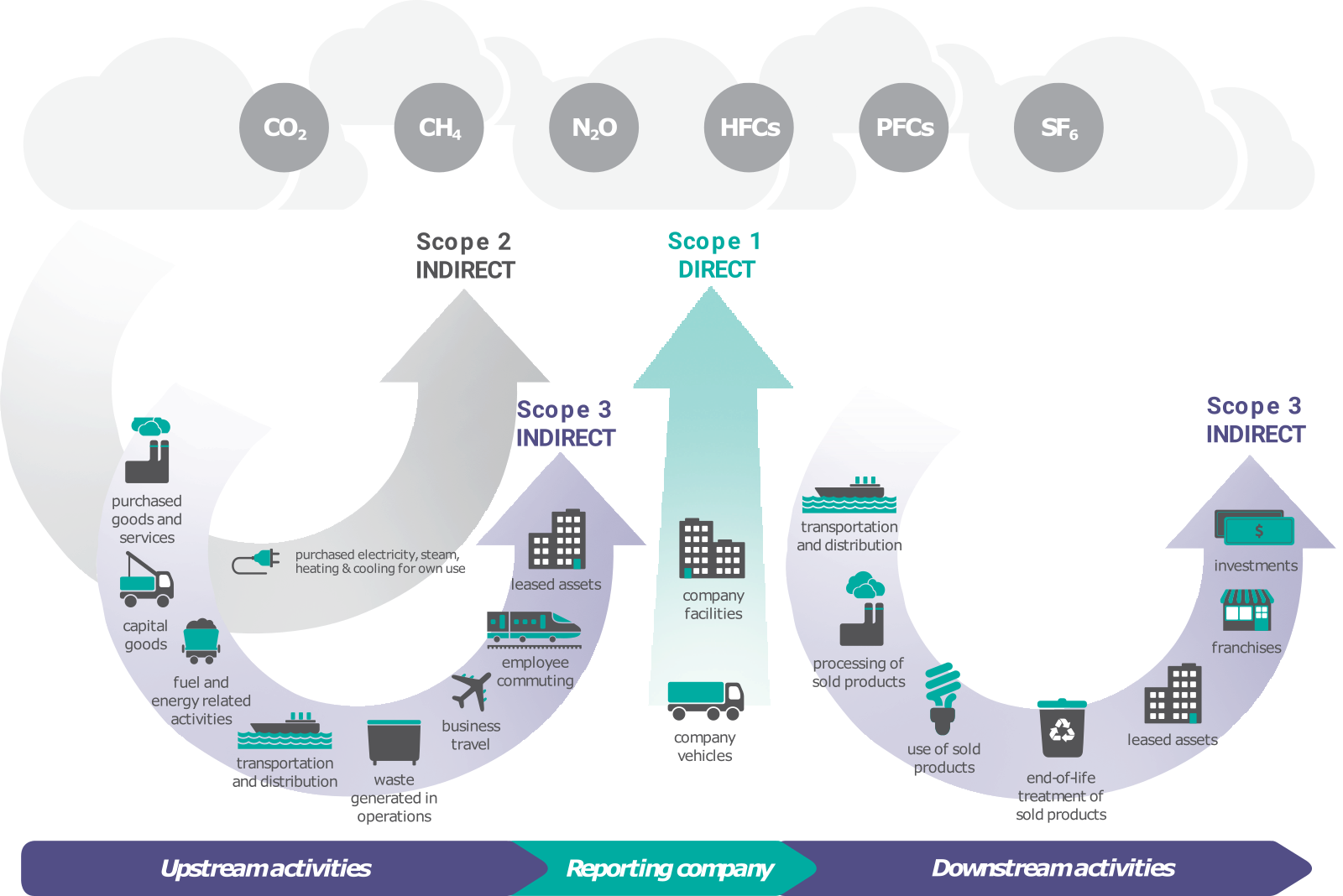
In addition to carbon dioxide (CO2), according to the ISO standard 14064-1, all other greenhouse gas-relevant emissions must also be included in the calculation when creating a CCF, such as methane (CH4) and nitrous oxide (N2O) (DIN, 2019). According to the GHG Protocol, the collection of greenhouse gas emissions takes place in three so-called scopes (WRI, WBCSD, 2004):

Scope 1: Direct emissions from internal company processes

Scope 2: Indirect emissions from energy consumption

Scope 3: Indirect emissions (upstream and downstream value chain)

ghg scopes 5f9d30d0 1920w

Figure 1: GHG Scopes 1-3; Source: Excerpt from the GHG Protocol

The collection of emissions from Scope 3 companies poses major challenges. While a company has the least control over Scope 3 emissions, these emissions are usually the biggest lever for avoidance and reduction, as they often account for the largest share of the greenhouse gas balance, especially for manufacturing companies.

At Procycons, the creation of a CCF takes place in five steps:

1. Analysis of the company structure and identification of important stakeholders

In the first step, the company structure and business activities are analyzed with a view to the aspects relevant for a CCF. Climate reporting is also relevant for external stakeholders, such as business and end customers, legislators, investors, owners, etc., via internal communication and strategy development. These stakeholders are identified in advance together with the company.

2. Definition of the boundaries of responsibility

The definition of the boundaries of responsibility determines the scope of the CCF investigation. Here, in particular, the question arises for which activities, product life cycle steps, and emissions of the upstream and downstream value chain (Scope 3) the company sees itself responsible for, or which activities should be included in the calculation of the greenhouse gas balance. In addition, it is defined which greenhouse gases are included in the balance.

3. Balancing of the greenhouse gas emissions of the three scopes

In order to balance greenhouse gas emissions, data must first be collected – internally and from stakeholders. For example, information from suppliers on distances, weights, and transport types must be obtained to calculate transport emissions in the upstream value chain.

By assigning this data to emission data from recognized, standardized databases (e.g. ecoinvent, ProBas, and Defra), emission values for the balancing can then be calculated. This process is carried out for the activities of all three scopes and all relevant greenhouse gases. The calculated values are professionally checked for relevance, completeness, consistency, coherence, accuracy, and transparency.

blog3 zitat2 1920w

4. Analysis and preparation of the results

The greenhouse gas balance is finally analyzed and emission hotspots are identified. In addition, the results are visually prepared in a transparent and authentic manner and put into writing for the relevant stakeholders defined in advance (e.g. in the form of a sustainability report). The balance and its analysis serve as the basis for the development of a decarbonization strategy and an action plan for emission reduction (see steps 2 and 3).

5. Certification of the greenhouse gas balance

If the company wishes, Procycons has the CCF certified by an external auditing company (e.g. GUTcert or TÜV). On the one hand, certification ensures the reliability of the information provided and, on the other hand, increases integrity and transparency towards stakeholders.

Basic Principles for the Path to Net-Zero: What are Science Based Targets?

In order to limit global warming to 1.5°C, the Science Based Targets initiative (SBTi) sets out basic principles according to which companies can set net-zero targets. In contrast to simple net-zero targets, science-based targets require a decarbonization path based on climate science. Companies that want to make a significant contribution to reducing climate change should rely on science-based targets. The Carbon Management Hierarchy of Andrews (2014) suggests that carbon sequestration should only be considered as a last resort. The SBTi basic principles make the foundations of climate science tangible and implementable to support companies in climate management.

Decarbonization Strategy, Action Plan, and Scenario Analysis

The development of the decarbonization strategy is based on an internal analysis of the strategic starting position and an external analysis of the business environment. When evaluating these analyses and developing strategic goals, a balance between economic framework conditions and ecological requirements is strived for.

In addition to determining customer needs, a technology trend analysis is part of the internal analysis, in which new technologies are examined for their relevance with regard to the sustainability performance and the business activities of the company. In the external analysis, it is checked to what extent the company is affected by current and future political and legal framework conditions (e.g. Supply Chain Due Diligence Act, Federal Climate Protection Act, Circular Economy Act). On the other hand, a competitive analysis is carried out using ESG criteria.

Based on these strategic investigations, the action plan and the scenario analysis are developed, which pave the way for the decarbonization of the company. The overriding goal is to evaluate which measures are ecologically sensible and economically viable in order to achieve corporate greenhouse gas neutrality. The Carbon Management Hierarchy according to Andrews and the principles and conceptual foundations of the Science Based Targets Initiative (SBTi) are of essential importance.

For the creation of a measures long list, it is necessary to examine every sub-area of all three scopes in the company’s climate balance for reduction potentials (see Figure 1). These measures are then examined for their feasibility and prioritized according to their effectiveness and efficiency. The resulting short list is finally bundled in various decarbonization scenarios.

The result is a roadmap with various scenarios for quantitative, binding, and realistic greenhouse gas reduction targets that correspond to the fulfillment of the German government’s climate targets and thus to compliance with the Climate Protection Act.

Outlook: Product Carbon Footprint, CO2-Neutral Products, and Life Cycle Assessments

A company that has recorded its Corporate Carbon Footprint and developed strategic measures to achieve greenhouse gas neutrality has set important cornerstones for the ecological transformation of its business activities.

In the long term, after the establishment of this overarching strategy, the product portfolio must be ecologically optimized. The procedure here is similar to the decarbonization of companies: First, a Product Carbon Footprint (colloquially ‘CO2 footprint’) is recorded. This determines the greenhouse gas emissions or the global warming potential of a product over its entire life cycle – from raw material extraction and processing, to transport, production, and use, to recycling or disposal. After hotspots have been identified in the greenhouse gas balance, all processes have been optimized, and CO2 reductions have finally been achieved, the aim can be to have the product certified as greenhouse gas neutral by CO2 compensation of the remaining emissions.

A more holistic approach is offered by the Life Cycle Assessment (or LCA). Methodologically, the procedure is similar to the Product Carbon Footprint, but now several impact categories or environmental impacts are considered. These can be, for example, the contribution to acidification, eutrophication, or ozone depletion.

Summary

The blog series aimed to break down sustainability reporting and decarbonization from the macro level of the EU (CSRD) to implementation at the company level. The first article gave an overview of the upcoming changes in sustainability reporting for companies due to the CSRD and the frameworks available for this purpose. The second article focused on the three frameworks recommended by Procycons, DNK, GRI standards, and ESRS, and went into more detail on their ecological and climate-relevant requirements. Against the background of these climate-relevant requirements and the Climate Protection Act of the Federal Republic of Germany, the third article described step by step how Procycons accompanies companies on the path to decarbonization.

The CO2 clock of the Mercator Research Institute on Global Commons and Climate Change (MCC) shows the urgency of the ecological transformation: If CO2 emissions remain constant, the CO2 budget for meeting the 1.5 °C target will be used up in less than 7 years (as of February 22, 2023) (MCC, 2023). The resulting timeframe is significantly tighter than the time pressure that results from complying with legal obligations. There is no way around a greenhouse gas neutral economy. To achieve this goal, every company can make a valuable contribution by decarbonizing its activities in a timely manner.

References